
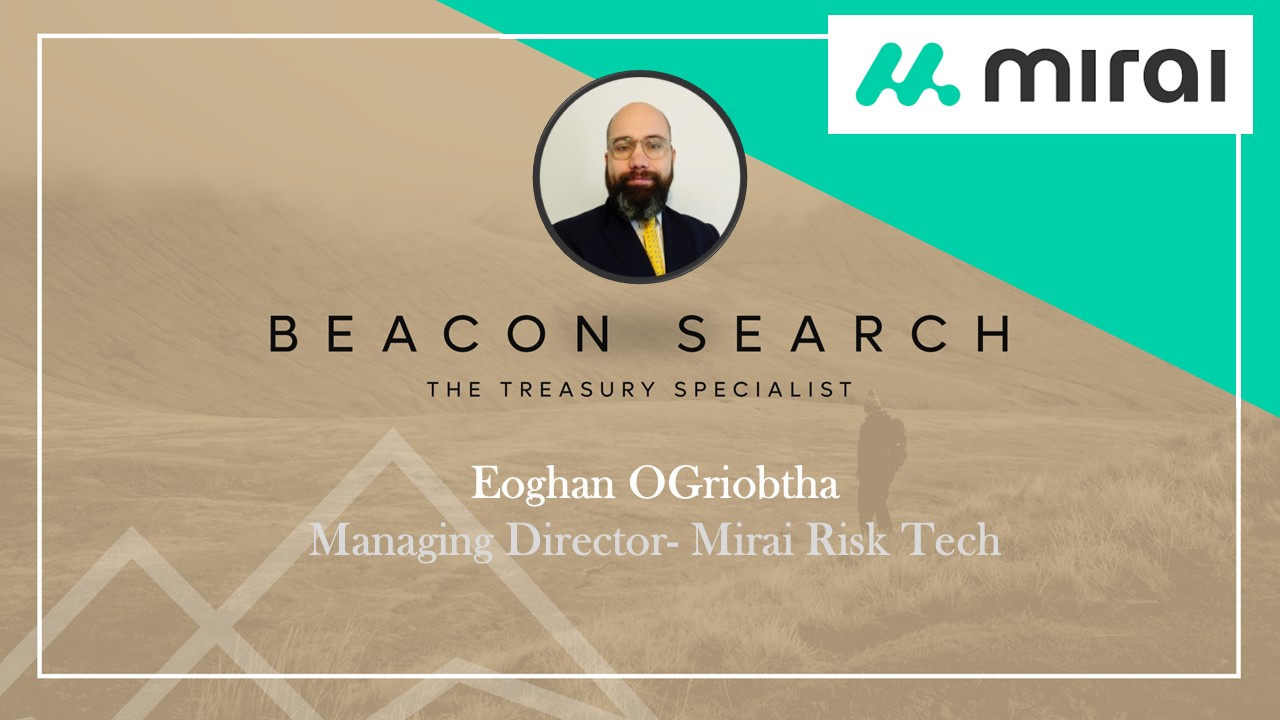
TREASURY CONSULTING/ADVISORY – WHAT YOU NEED TO KNOW WITH EOGHAN OGRIOBTHA
TELL US ABOUT YOUR TREASURY CAREER TO DATE:
I started my career at Accenture working for the Financial Services group. I had studied engineering so I was deployed to technical tasks such as building reporting and MI tools. I migrated to the risk space where there was somewhat of an overlap in the maths and methods.
I took the leap to the business side a few years into my Accenture career and ended up in the Captial and ALM transformation team at HSBC where I lead ALM systems. I had the good fortune to arrive at a time of change at the bank which led to some really interesting work. We unified our global models which sprawled across 50 global entities. In the process we embarked on a journey to building our stack in cloud technology, one of the first banks to do so globally.
Having gotten the bug for the power of these new technologies Ive been working for the past 5 years for fintechs and helping banks modernise their technology stack.
WHAT ATTRACTED YOU TO TREASURY ADVISORY/CONSULTING?
Being able to work on different projects and getting insights to different areas or clients always appealed to me. Although one thing that I hadn’t appreciated initially in my career was that even with this you need to build a core expertise, be that in technology, or a particular specialisation or delivery perhaps.
HOW DO INTERNAL TREASURY ROLES COMPARE TO ADVISORY/CONSULTING POSITIONS?
Working on the bank side you need to think long term, at least medium term. You set a strategy and make it work over that period. You need to balance strategic direction with getting the nuts and bolts of the day to day done.
With consulting you are in a much more strategic role. You give advisory guidance, deliver projects and guide them to the initial benefits realisation. But then its up to the client. This can lead to scepticism about consultants and it’s something at Mirai we are very conscious to ensure we deliver high quality with clear lasting returns.
Mirai is a good fit for me as we are mostly ex bank, I like to say ex practitioners. We have practical understanding of the bank side and know that for our strategies to work it needs to be implementable.
WHAT PERSONALITY TYPES WORK BEST IN THE TREASURY CONSULTING SPACE?
Clever and hardworking is a good start, the same as every other job! Aside from that consulting has many different areas people can get into that can suit multiple different personalities. If I were to pick three great traits useful across all of our capabilities I would say: A natural curiosity, you may be thrown into multiple different areas and be required to get up to speed quickly. A bias to action and the willingness to try new things, this is highly related to curiosity but its action point to it. Finally, it really helps if you get on with people. This doesn’t necessarily mean the extrovert centre of attention type, it is more like being able to find common ground with people to work at your collective best, especially people since you will be working with new clients all the time.
WHAT TYPE OF TREASURY PROJECTS ARE YOU GENERALLY ENGAGED IN AND HOW MUCH CHOICE DO CONSULTANTS HAVE TO CHOOSE THEIR PROJECTS?
Mirai is a specialist in Banking Treasury and ALM and Banking Risk. Our market offering has four pillars. Firstly Advisory where we would assist bank leadership set the strategy, give senior SME input or even benchmark functions versus the market. Our second offering is project delivery and managed services. We have delivered IT projects such as risk data warehouse and systems implementation and business initiatives such as implementing risk operating models. The follow on from this is the managed service where we manage whole risk BAU functions for clients. We offer staff augmentation where we place consultants into bank team as an SMEs. Finally, we have our own SaaS tool for ALM, Liquidity, FTP and Regulatory Reporting. We are very proud of this application; it has best in class modelling and performance and is helping our clients modernise their functions and put them on the path to AI.
WHAT ARE THE HOURS LIKE?
This is the tricky part of project work. The hours can be long especially coming up to a deadline. But at Mirai as management we aim to make these few and far between. If it does happen it is discussed as part of our project debriefs to ensure its not a regular thing and any corrective action can take place. We have a very low churn rate but deliver exceptional projects so I think we get the balance right.
HOW MUCH SALES/ BUSINESS DEVELOPMENT IS EXPECTED IN THE TREASURY ADVISORY SPACE?
The glib answer here is that everyone needs to know how to sell. If you can’t articulate your ideas effectively you will not be able to reach your highest potential impact in life.
The more direct answer is that this is an important part of all levels of consulting. But it is often not what people think it is. Sales is really the combination of identifying problems clients are having with the identification and suggestion of effective solutions.
At Mirai we follow a consultative sales process, this works as many of our staff have experience on the bank side so we have real empathy with the challenges thrown up. Of course we give training on consultative sales best practice.
For technical people put off by the idea of sales, I would say maybe have a look again. I is really just problem solving and gives you the chance to showcase your ideas.
HOW DIFFICULT IS IT TO MOVE BACK INTO AN IN-HOUSE ROLE WITHIN A BANK OR CORPORATE FROM CONSULTING?
There are definite paths to this. Often it is where you have built a particular expertise in a specific area and a particular relationship.
Taking a step back, I think of Barack Obama’s advice to people at the start of their careers, be useful. It’s good advice at all levels and relevant here.
It’s hard to plot an exact career trajectory. If you find something you’re good at and are delivering well, it will create opportunity, at both your current job and elsewhere. But do start from where you are. Be useful, be good and the rest will come.
WHAT DOES THE NEXT 5-10 YEARS IN THE TREASURY CONSULTING SPACE LOOK LIKE? MORE REGULATORY OR TECHNOLOGY FOCUSED?
How long do you have? Now is definitely the most exciting time of my career. Inflation and rate volatility are creating a lot of uncertainty which drives work for Treasury. Geopolitical risk poses a very large risk to manage. We are seeing AI transforming our and every industry. Finally banking itself is seeing unprecedented competition across all its spaces from new market entrants as diverse as fintech banks, bankless payments rails and even the crypto ecosystem.
Banks like most industries are in the process of modernising their core infrastructure to take advantage of this. We are assisting many clients utilise wider banking information to manage risk and create comparative advantage.
Banks will need to continue their digital journeys. However it does appear that AI is most responsive to quantity of data, this may mean reengineering data and systems stacks to better utilise these tools.
There will certainly be a regulatory aspect to this, however the current trend is for ad hoc inspection rather than prescriptive reporting.
HOW HAS BEING A CONSULTANT/ADVISOR MADE YOU A BETTER PROFESSIONAL?
An interesting question. I think you would like to think everyone works to become a better professional. For certain in consulting from an early period in your career you often get senior exposure. This means learning quickly how to interact with executives and senior management. In the early days the things that struck me were, be very prepared, be very precise and concise, and most important have your analysis but always take a view, you will be asked.
ANY ADVICE FOR ASPIRING TREASURY CONSULTANTS OUT THERE?
I can’t think of better advice than Obama’s be useful. No matter what you are doing currently there will be value you can bring to the table that a potential employer needs. Find it and communicate it well to your prospective employers.
As some ideas, areas where people are very useful for us include: Cross functional areas. If you understand Treasury to some level but also technologies for instance. Especially if you know modern tech like cloud native technologies, ML and AI. Bank side expertise. Don’t underestimate the power of what you know working on the bank side. At Mirai we have a strong bias for hiring ex bank to ensure we’re experts in the practicalities of our solutions not simply the theory.
FOR MORE INFORMATION ON HOW MIRAI CAN HELP YOUR BUSINESS YOU CAN CONTACT EOGHAN OGRIOBHTHA AT eoghan.ogriobhtha@mirairisktech.com
www.mirairisktech.com

