
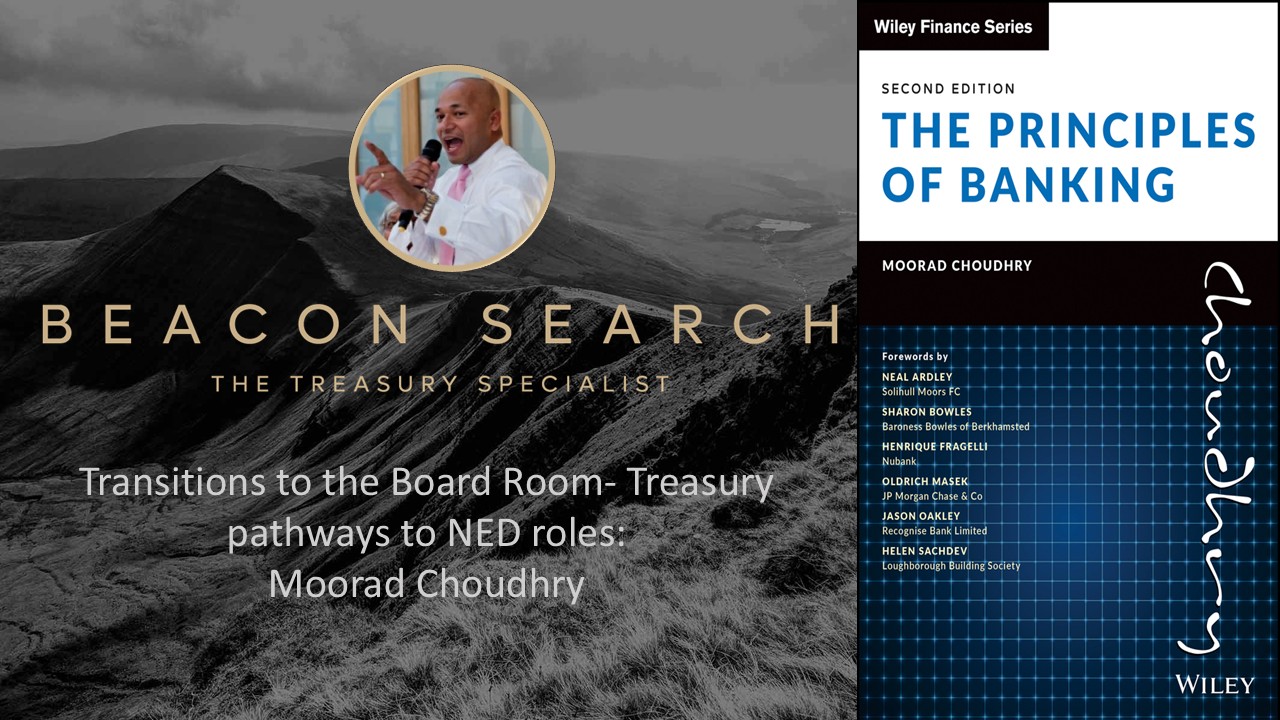
Transitions to the Board Room- treasury pathways to NED roles: Moorad Choudhry
TELL US ABOUT YOUR CAREER TO DATE:
Well it’s been a long one – or at least it feels like it! From the beginning then…I made about 80 applications for graduate entry roles when I was on the MA Economics programme at Reading University, back in 1988-89, and ended up with three offers. One of them was at Lloyds Bank, and for the last 36 years I’ve never stopped regretting that I didn’t take up that one! I joined the London Stock Exchange, then from there spent the next 15-odd years in wholesale markets, in the main with Hoare Govett Securities as a bond trader, JPMorgan Chase in structured finance, and KBC Bank as Treasurer of their UK investment banking arm (KBC Financial Products). Then it was the next 10-odd years in commercial banking, with Treasurer roles at Europe Arab Bank and Royal Bank of Scotland. I’ve been on the NED track the last six years.
YOU BECAME A MANAGING DIRECTOR IN 2010 AND ULTIMATELY CHIEF EXECUTIVE OF A BANK IN 2015, BEYOND CONTINUING TO CLIMB THE CORPORATE LADDER, WHAT OTHER CAREER OPTIONS REMAIN AVAILABLE TO CANDIDATES AT YOUR LEVEL OF SENIORITY?
In terms of career “progression” or “advancement” (two value-laden terms) it does become harder simply because it’s a pyramid, so the number of roles available is fewer. I would certainly recommend looking at academia, and teaching and lecturing at University as well as at professional training organisations. And then of course there is the NED route. However there is clear blue water between the real roles and purpose of execs versus non-execs, or at least there should be at any firm, and so for that reason being a NED won’t suit everyone. In essence it involves sitting in committee meetings for long periods of time and reading lots of dense, and long, committee papers! There is also a trait that sometimes helps, and which not everyone possesses (I certainly don’t), and that is the art of talking a lot without saying anything. If one is at home with all that then that’s handy. But it’s a logical progression for those who have acquired valuable practitioner experience in the banking space and wish to apply some of that knowledge and judgement in a value-added but different way.
YOU HAVE HELD SEVERAL NED POSITIONS OVER THE LAST SIX YEARS, CAN YOU TELL US, WHAT IS THE ROLE OF A NED?
There is actually a formal definition of this in publications such as The Director’s Handbook and the Cadbury report. Personally, I view the role of the NED to be the independent objective Board director who is there to review and guide the bank’s strategy, as well as its risk management process effectiveness, and both in a meaningful way. The NED is also there to hold the Exec to account. By definition it’s a high-level role: the NED shouldn’t be down in the weeds, it’s a higher level oversight, review and challenge function, and also a support and advisory role. On the Board of Governors at Claremont Fan Court School (one of my non-remunerated roles) they use the expression “a critical friend”. That’s a good description of the NED role. And of course in practice there is some variation in this amongst individual NEDs themselves, because they bring their own personalities and approaches to the role. Some NEDs are more hands-on and talk a lot at Board meetings, and make lots of comments on papers and submissions, whereas others are more hands-off and speak only when they have real value to add and limit their comments in documents to material points.
WHAT FIRST ATTRACTED YOU TO NED POSITIONS?
There was the bit about using my knowledge and experience acquired over 30 years working in the City, and “giving back” to the industry and indeed to wider society. My first Board positions were in the voluntary sector, and I also served one term at a Housing Association (where the NED salary might be one tenth of the average City NED salary). I wanted to work with banks in a way that would help firms in a genuine and practical way…but I’ll be honest, I also liked the idea of being able to spend more time with my family!
DID YOU CONSCIOUSLY MANAGE YOUR CAREER TOWARDS OBTAINING A NED POSITIONS?
No, not at all, in fact almost the opposite. I was working towards the CEO position (I remember walking past the offices of SG Warburg one evening during an office XMas party night out and saying to one of my colleagues, “I’d like to be CEO of them one day!”. Sadly that firm was swallowed up by a bigger bank many, many years before I got anywhere near a senior exec position! So I was never to achieve that particular ambition :-). It was only after I left full-time work that an opportunity arose at a bank, quite by chance, and I grasped that one with both hands.
HOW HAS YOUR TREASURY, RISK AND MARKETS EXPERIENCE EQUIPPED YOU FOR ROLES IN THE NED SPACE?
Actually very, very well. Many NEDs dont have any direct experience in these areas (the stereotype of the typical Board NED being an ex-Audit Partner from one of the Big 4 firms is not an inaccurate one) and yet managing the balance sheet, and ensuring good risk governance at the bank, are one of the most important responsibilities of a NED. So this experience is invaluable, and often sought after. (The former Audit Partner is also still well sought after! 🙂 ).
YOU’VE HELD SEVERAL NED POSITIONS WITH A VARIETY OF INSTITUTIONS OVER THE LAST DECADE, WHAT TYPES OF SKILLS ARE THESE ORGANISATIONS TYPICALLY LOOKING FOR IN A NON-EXECUTIVE DIRECTOR?
It varies, and it’s wide ranging. It also depends what type of firm (large bank? small bank? start-up bank? “Fintech”?). If I was to generalise, I would say (1) an understanding of strategic thinking, so one can have a 5-7 year view of the firm (2) the ability to exercise good judgement, born of experience, such that one is able to grasp an issue and debate the best solution with the exec right away (3) an ability to grasp the key points on balance sheet position, quickly, from the board pack (4) good general “team” skills so that one can discuss issues at a committee meeting with equally senior people of differing personalities in a way that advances the debate (5) an ability to actually take a decision. Here is my favourite illustration on this one: two NEDs are on the bridge of a ship, which is faced with a typhoon ahead. The captain asks each NED whether they should sail thru the storm or around it. One NED answers with their choice. The other NED says, “I see merit in both options!”. Which NED do we want on our Board? And finally (6), what Phil Jenks, my Chair at Recognise Bank, a gentleman of the highest quality and right up there with the finest Chairs at any bank, said in his endorsement of my book: “He has the rare skill to bring together his fellow Directors, even in challenging scenarios.” Thank you Mr. Jenks! 🙂
WHAT IS THE PROFILE OF A TYPICAL NED?
There is these days much variety in NED profiles, regards backgrounds and skill sets. But if I was to state the typical profile I would probably say semi-retired, with an audit or accounting background, and more and more with risk or regulatory backgrounds.
IN AN EVER-CHANGING REGULATORY LANDSCAPE, HOW DOES ONE NOT IN THE TRENCHES DAY TO DAY STAY ABREAST OF THE CHANGES IN THE INDUSTRY?
Very good question! With effort. It takes proactive engagement to ensure one does stay on top of latest developments. One of the first things I did was subscribe to BoE, PRA, FCA, EBA and BIS (BCBS) publications so I would be aware of all latest regulatory guidance as soon as they were published. I also recommend attending courses on topics outside one’s direct background (I have actively sought out cyber risk, financial crime and operational resilience related courses for just this reason), and attending industry conferences regularly. Or better still, speaking at them! Nothing focuses one’s mind on learning about the latest changes in the industry more than knowing that one will be speaking about them in front of hundreds of practitioners in short order.
WHAT DOES THE TIME COMMITMENT FOR AN NED LOOK LIKE ON AN ANNUAL BASIS?
Again, varies by firm, as does the level and frequency of engagement. Most banks have monthly Board meetings and regular sub-committee meetings. Some have quarterly ones. As well as time spent at meetings and reading Board papers, it is important to have regular catch ups with key execs and other non-execs. I would suggest all-in-all expect the time commitment to be, at least, 5-6 days per month, for some firms more like 7-8 days per month.
WHAT SKILLS DO YOU THINK FUTURE NED’S WILL NEED AS WE WITNESS THE EVOLUTION OF TECHNOLOGY AND AI IN TREASURY?
Just that! An understanding of AI and its use in banking, which means getting familiar with the opportunities as well as the risks and the challenges. This is a very dynamic environment at the moment, my answer to this question will probably also be changing from quarter to quarter! 😅
ARE THERE ANY NON-COMPETES IN RELATION TO HOLDING MULTIPLE NED ROLES?
Yes and they are important to stay on top of. I believe the FCA has a rule stating that a maximum of 4 paid NED roles can be held at any one time (two if the NED is also an Exec somewhere). A NED can only take on an additional NED role if there is no conflict of interest with their existing role(s).
WHAT DOES THE REMUNERATION PACKAGE FOR A NON-EXECUTIVE DIRECTOR LOOK LIKE?
NED roles are usually paid as a straight Director’s fee only, as opposed to an employee salary, so outside of the pension plan. I have seen some NED positions that are included in the firm’s pension plan though. I’ve never come across any that included a bonus structure. As you can imagine, the pay range is very wide. Depends on the firm and the space it’s operating in, naturally.
HOW DOES ONE GO ABOUT OBTAINING AN NED POSITION? VIA YOUR OWN NETWORK OR SPECIFIC NED HEAD-HUNTERS?
Both! One’s own network, via headhunters and also websites such as Nurole that advertise positions. It’s worth getting experience in the voluntary sector as well. My most recent was as Chair of the Audit & Risk Committee at Goldsmiths, University of London. That was very challenging, I learnt a fair bit in that role.
Moorad is the author of several industry leading books on banking and treasury management, you can get yours at the following links:
Amazon
https://www.amazon.com/Principles-Banking-Wiley-Finance/dp/1119755646/
Publisher
https://www.wiley.com/en-gb/The+Principles+of+Banking%2C+2nd+Edition-p-9781119755647

