

2024 Challenger Bank Treasury Recruitment Market Review
To begin our review of 2024, we firstly need to cast our gaze slightly further back in time to the turbulent months of March/April 2023 and the Silicon Valley Bank crisis and acquisition of Credit Suisse by UBS. These events, coupled with rising interest rates and Governmental change across several western markets led to a collective contraction across the industry and dampened appetites for general project and recruitment spend. The recruitment market has often acted as a bellwether for economic conditions. It has been estimated that more recruitment companies have wound up operations in the past 18 months in the UK than during the financial crisis of 2008. This provides a tangible insight into what many of us have experienced in the market since that time. Beyond the outlying regulator driven transformation projects on-going at HSBC, Standard Chartered Bank and Citi Bank where some volume of hiring has continued to take place, for the most part many organisations have opted to continue to freeze all but non-essential hiring from March 2023 and up until today we have not yet seen a collective recovery and return to market.
What does that mean for the Challenger Bank sector? In brief, the position of most organisations across the Challenger Bank sector was to consolidate, stabilise and, in some cases, even reduce headcount where possible. There are of course a few organisations that continue to work through transformative initiatives and some that are planning to grow Balance Sheets but for the most part it was a case of batten down the hatches in 2024.
Many of us recall the Regulator’s call for more competition in the Challenger Bank space some 10 plus years back. In the past 12 months we have witnessed many of the Banks’s emanating from that period go through mergers, acquisitions and in some cases wind down operations all together. Though timelines are unpredictable this will no doubt lead to a large population of treasury candidates entering what is currently a job light market in the coming years as these transactions bed in.
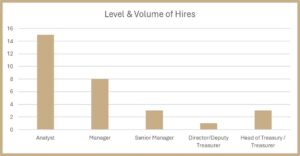
For the hiring that has taken place throughout 2024 in the Challenger Bank sector it has predominantly been at the Analyst, Senior Analyst level. Juniorisation has been an on-trend word across the Financial Services industry of late, it effectively proposes to replace experienced hires with cheaper, younger alternatives.
The technical focus of hires has predominantly been on the IRRBB, Structural Hedging and Data/Programming side and while younger candidates bring a better functional knowledge of programming/coding they will of course lack experience in managing balance sheets through turbulent periods, especially as interest rates potentially fall. Again, there are of course some outliers in terms of senior hires, but these have been few and far between. The data collected is based on the 21 Banks who participated in this study.
Cross Sector Hires 2024
PERMANENT: 25 Hires
FIXED TERM CONTRACTS: 4 HIRES
CONTRACTORS: 2 HIRES
INTERNAL: 2 HIRES
So, what’s changed on the treasury hiring front? As a business we have continued to observe that most treasury job descriptions will now ask for Python, SQL, C++ or similarly associated programming skills. Balance sheet management, regulatory knowledge and an understanding of managing large data sets will become common place moving forwards is our feeling. A general focus of many organisations is better understanding and organising their own data to produce stronger behavioural models and improve balance sheet decisions moving forward.
Can AI play a part in balance sheet management? Many of the younger generation coming through are much more familiar with AI than their predecessors and have some fascinating insights on how it can best be deployed to improve efficiencies. From those canvased as part of this research artificial intelligence is being used successfully for a myriad of topics from policy documentation purposes, writing code for data aggregation and model development. Automating payments, reconciliations and reports is saving a substantial amount of time for Treasuries. Nonregulated institutions are much less constrained in its deployment, nevertheless we certainly expect AI to play a much larger part in regulated treasury functions in the coming years. The new generations mastery of tools like Chat GPT, Open AI, Gemini open a new perspective for those senior leaders open to embracing the technology.
What about opportunities outside the Banking space? Many of you will have seen and may even know colleagues who have made the move outside the classic banking space and into the payment sector. It is a highly competitive space and has attracted leading treasury talent to make a change. Roles in this sector differ dramatically to a classic banking treasury role. For more insights into the realities of life in this space please see our Articles and Insights page of our website where we speak to those who reflect on their experiences having made the jump. Not enough time has passed yet to see if it’s possible to make the move back for those who have been away from the regulated treasury sphere for some time.
How are Treasuries attracting talent? It’s been widely commented that treasuries are not always the most successful in marketing themselves and their activities to attract talent at the entry level. Unfortunately, we expect attracting the best young talent to only get harder in the coming years. Reports suggest that Technology companies are the preferred destination for graduates these days and can secure entry level profiles for salaries of £30,000, almost £10-15,000 less than retail Banks are currently offering with no bonus component.
Treasury functions hoping to secure the brightest minds will need to be creative in their offerings to secure candidates at this level. Being more tech focused will no doubt appeal to many. Forbes reported the number of applicants for the Chartered Financial Analyst (CFA) exam has been declining since the COVID-19 pandemic. The decline is estimated to be around 40% from its peak and while there are many reasons for this it is in large part that many graduates have been choosing other paths or industries over Financial Services and as such don’t require the requisite qualifications.
Post Brexit the UK markets access to non-domestic talent has of course been curtailed in the years following 2016. This has directly impacted the market in many ways. From a hiring perspective, the largest international banks have been forced to re-evaluate their expectations of candidates’ experiences. Barriers that historically existed limiting candidate movement between Retail Banking and Investment Banking based on product knowledge have all but disappeared. We have witnessed moves from regional Building Societies to Tier One Global Bank treasury functions in the past few years and even some hires from Corporates. This means that any meaningful return to market by the larger international Bank organisations in the future leaves Challenger Bank functions open to be raided.
So how can Challenger Banks compete? Candidates’ priorities have changed a lot since the pandemic and many organisations have been very successful in recognising this change. Not all candidates are driven solely by compensation and organisations that offer flexibility can compete in other ways. Many of the Global Banks have been quick to re-introduce mandatory working from home arrangements based on a three-two split. Most individuals appreciate the benefits of team cohesion but are left scratching their heads at needing to commute in to sit at a “hot-desk” surrounded by non-treasury peers and attend virtual meetings.
This has presented an opportunity to nimbler organisations who offer anything from a dedicated treasury working space in the office, dedicated team days or flexibility to work remotely.
The latter has been highly prized by more experienced candidates and met with mixed feelings at the junior end. There is much to be said for learning through osmosis and getting long term exposure to more senior colleagues and there have been examples of less experienced candidates leaving organisations for the lack of in person contact or feeling isolated. Managers are having to think a lot more about the staff offering and how they engage their teams. The proposition to work remotely has allowed regional organisations to access a new pool of talent where remote/flexible working arrangements can be offered.
Balance Sheet Size & Headcount Composition
The below graph gives an anonymised indication of Bank Balance Sheet Size against team Headcount, a topic many Treasurers are interested in, especially in the start-up environment. The data was collected from the 21 Banks who participated in this study:

Treasury Benchmarking
Full UK Markets Treasury Benchmarking

London Centred Banks

** Salary ranges at the Treasurer end can vary depending on balance sheet size and team headcount. Additionally, some individuals have taken on a wider mandate beyond Treasurer and are compensated accordingly.
** Bonus compositions are structured by organisation. Some are fixed and contractual, some are performance based and made up of shares/cash. Many packages carry LTIP elements, and some packages are paid out on a deferral basis.
If you’re interested in being benchmarked against your immediate peer group, please reach out and we can arrange an anonymised but tailored benchmarking call.

