
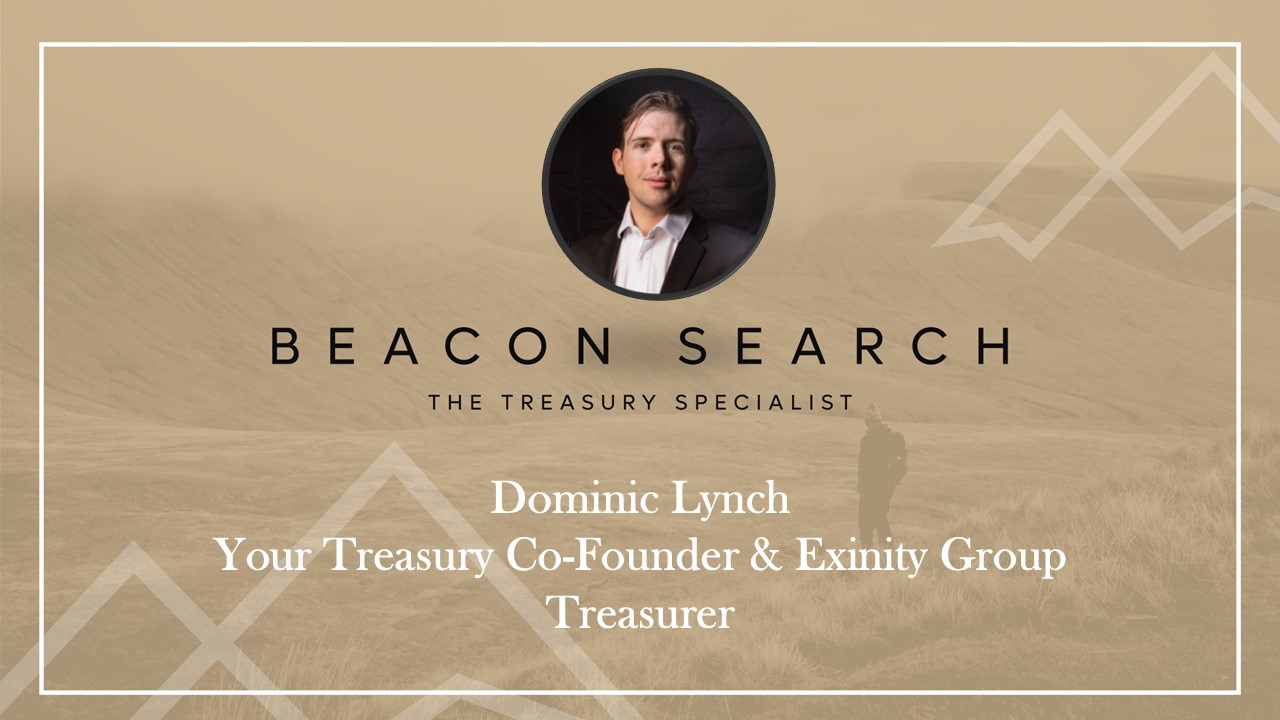
Introduction- Tell us a bit about yourself and your new venture, Your Treasury.
I’m Dominic Lynch, I’m currently the group Treasurer of Exinity, a leading Broker in the derivative and digital asset space. My career began in the derivatives and financial risk management, and it expanded quickly into liquidity and cash management. My time in the industry has been defined by creating value through expanded my skill set from the treasury norm and story telling.
At my previous roles at Bitpanda and GoStudent I encountered the challenges of technology managing and tracking crypto out of the box didn’t exist and their are still some limitations constrained by business models. We had to be creative with the resources we had. I experienced through my career how treasury sets a very low benchmark in showing our value to the organisation and showing the value, it can generate, and that is not our fault, it’s I believe in our education.
From these experiences I co-founded Your Treasury with James Kelly, a venture aimed at helping treasurers navigate a future of rapid technological change and lead them on transformation. Your Treasury focuses on equipping teams with the tools and skills to harness AI, automation, and data analytics, shifting treasury from an operational role to a strategic powerhouse within the organisation.
What is AI and how can Treasurers start to utilise its functionality to gain a competitive advantage?
AI is reshaping treasury by providing treasurers with insights and efficiencies that weren’t previously possible. At its core, AI uses models and large data sets to recognise patterns, make predictions, and automate tasks.
For treasurers, this means everything from supporting the construction of payment file mappings to optimised investment decisions, improved data visualisations and answers to strategic questioning. But do not start at cashflow forecasting! If you can’t understand it an AI model isn’t going to help. AI right now should begin as a treasury assistant, starting with high-impact applications. Automating routine tasks or supporting you in building automation can allow treasury teams to gradually integrate AI, making treasury more proactive and data driven. Treasury is I believe the easiest department in the organisation to see ROI in technology transformation, as any efficiency we do will improve our ability to mitigate risk and improve financial performance.
What are the key challenges and considerations Treasurers face for integrating AI into existing treasury management systems, and where should they start?
AI integration isn’t just about implementing new tools; it’s about getting your team to be on board and think differently. AI is not going to take our jobs if we evolve. It’s a technology change, like moving from the CD Walkman to the iPod, we have a bigger menu of possibilities at our fingertips which should allow us to become more strategic in our role.
Rethinking data governance and establishing compatibility with existing systems. Many treasurers face the challenge of data fragmentation, as treasury data is often spread across multiple platforms and formats. Prioritising data integrity is essential, as AI is only as good as the data it works with. Treasury teams should start by focusing on a single project that addresses a specific pain point like improving data centralisation. This targeted approach allows teams to build small data foundations for AI to drive deeper analytics. You will discover the potential need for better connections to your systems via APIs and accidentally you will discover a new menu of automation possibilities. So it is better to start small and think big!
Can AI automate routine tasks such as reconciliations, payments, settlements, and reporting in treasury?
AI excels at automating the kind of repetitive tasks that often consume treasury’s time. Reconciliations, payment processing, and settlements are theoretically all automation driven, where AI can make the final leap is with the critical thinking for the last phase. I.e. What rule can I make, or I adjust to reconcile this new item. A chatbot that supports your payment queries these can all be handled by AI, reducing manual intervention and speeding up workflows. In reporting, AI tools can support the visualisation story. Questions can be raised if an AI chatbot has access to the datasets. This automation frees up treasurers to focus on high-value activities, such as strategic risk tasks, moving treasury from back-office support to a more dynamic, analytical role.
How does AI-driven analytics improve risk management, particularly in areas like interest rate and foreign exchange risk?
You can take a more exotic approach to risk management. For interest rate risk, AI can simulate various rate scenarios and their potential impacts on the balance sheet, providing a predictive view that informs hedging strategies, from a banking perspective this can look at multiple layers of prepayment risk and duration matching, which can significantly improve the cost of hedging. In FX risk, AI can monitor currency trends under various time horizons based on the business model. As mentioned earlier if you want to include non-financial data under a rules-based filtering it is possible. These insights, allow treasury to act before market shifts impact the organisation, but the big win here is scenarios can be run in less time and you can create new simulations easily.
What are the limitations or risks involved with using AI to manage balance sheets?
AI models rely on data quality, so poor data can lead to flawed predictions and risk exposure. Therefore, AI-driven decisions need careful validation and oversight to avoid over-reliance on automated outputs, therefore quality assurance checks and results need to be integrated in. The “black box” nature of AI models, where understanding the underlying algorithms can be challenging presents an added audit risk, especially in regulated environments. Treasury teams must implement robust governance to manage these limitations effectively and therefore choose the best approach, as there are great pre-ai existing models out there. Getting an AI to run multiple simulations of Seasonality model is more traceable then telling an AI model to take on the whole scenario.
Can AI work in regulated (banking) risk management, and are there additional considerations here?
AI models in banking need to be transparent, auditable, and explainable to meet regulatory standards. Treasurers should work closely with audit & compliance teams to ensure that AI applications are governed appropriately and comply with all relevant regulations. In addition, periodic audits and model validation are essential to maintain confidence and alignment with regulatory expectations.
Will AI replace jobs in the treasury function? If so, how should candidates think about adapting their profiles to remain relevant?
AI is transforming treasury roles, but it’s unlikely to make them redundant. Instead, AI will augment the treasurer’s capabilities, allowing them to take on a more strategic, data-centric role.
Candidates should focus on building technical skills in data analytics, machine learning, and coding languages like Python and SQL. Treasury professionals with a mix of financial and technical expertise will be better positioned to leverage AI-driven tools, making them invaluable as treasury becomes more technology-oriented.
How can candidates become more educated around AI and its application to the balance sheet, and what are the core skills they need to start this journey?
Candidates interested in AI applications for treasury should start with foundational courses in data science, machine learning, and programming. Tools like Python and SQL are invaluable, as is familiarity with data visualisation tools like Tableau or Power BI. Understanding how AI models work and practicing with real-world financial data can build confidence in applying AI to treasury functions. Practical experience with AI-driven projects or tools is the best way to build skills that will set candidates apart.
What courses does Your Treasury offer, and how can potential participants apply to join?
Your Treasury offers courses designed to bridge the gap between AI and treasury, focusing on practical applications like cash flow forecasting, chatbots and reporting. Our courses are hands-on and depending on the skillset start from the basics, allowing participants to work directly with AI tools and learn how to implement them within their own organisations. Interested participants can visit our website to explore course options and apply. At Your Treasury, we’re committed to empowering treasury teams to embrace a technology-driven future with confidence.
https://yourtreasury.ai/en/content/

